
All of our programs are built on the same foundation: the belief that leadership requires the ability to understand both yourself and the system around you, and to translate that understanding into effective action.
Across our programs, the foundation stays the same. What changes is the nature of the leadership challenge participants are preparing to face.
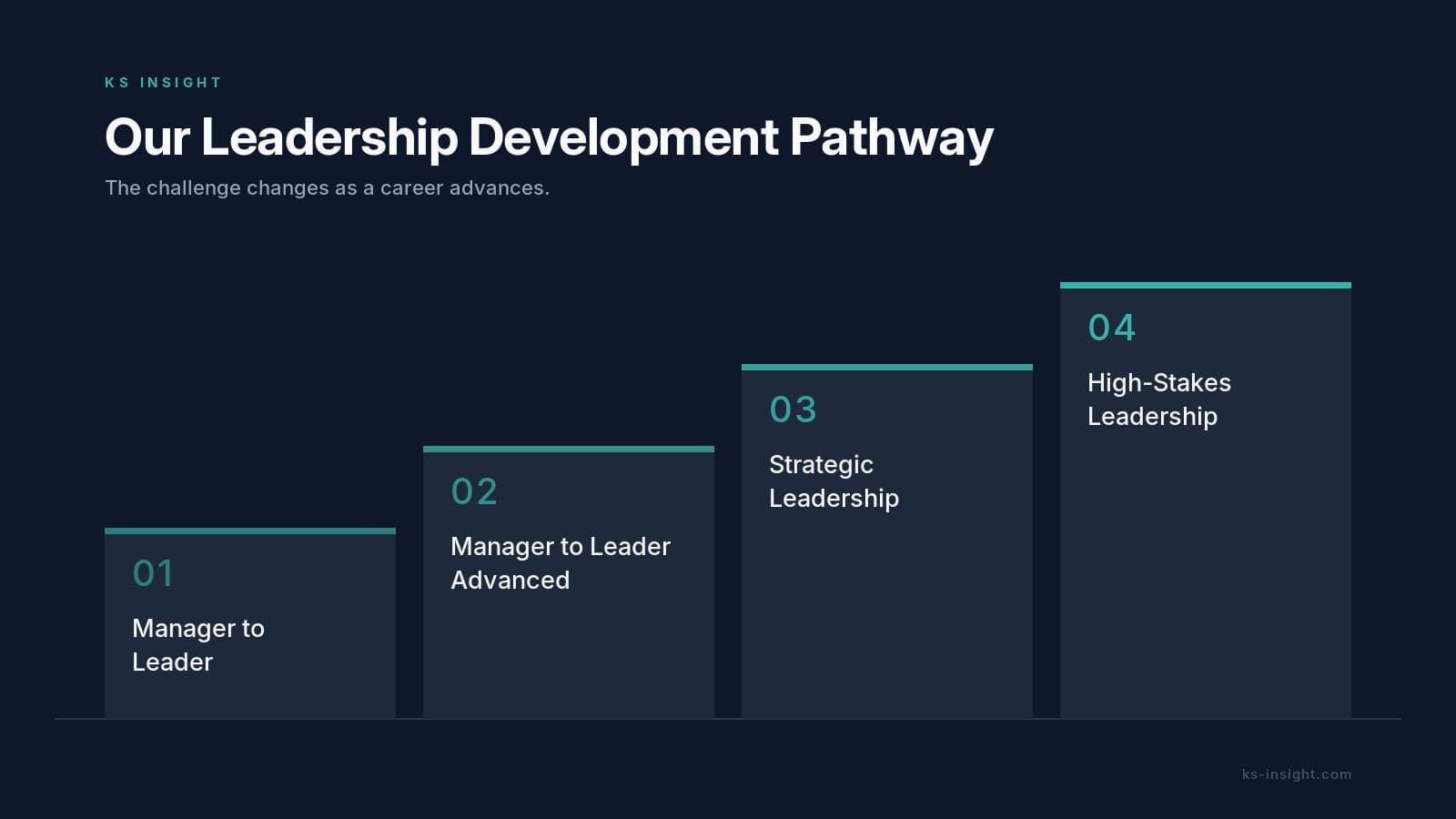
The challenge changes as a career advances. It starts with learning to lead people. It grows into leading through other leaders, where you can no longer touch every decision yourself. Later it becomes changing an organization, which is far harder than running one. And at the most senior level, the test is the leader’s own capacity to stay clear and effective when the stakes are at their highest.
Manager to Leader
The challenge is learning to lead people.
The transition from individual contributor to manager is one of the most significant shifts in a professional career. Success is no longer measured by your own expertise, effort, or execution. It depends on your ability to help others perform, grow, and succeed.
New managers must learn how to build trust, provide feedback, create accountability, navigate conflict, delegate effectively, and shape team culture. They must also learn how to use authority appropriately and avoid the common trap of solving every problem themselves.
At its core, the program helps participants make the transition from being responsible for their own work to being responsible for the performance and development of others.
Manager to Leader Advanced
The challenge is leading through others.
As leaders take on larger responsibilities, they discover that many of the tools that worked when leading a single team are no longer sufficient. They can no longer oversee every decision, monitor every relationship, or directly shape every outcome.
Success increasingly depends on their ability to align managers, influence peers, coordinate across functions, and create accountability across a larger part of the organization.
The challenge is no longer simply leading people. It is helping other leaders and their teams succeed together.
The program focuses on exercising authority at scale, leading through layers of management, managing competing priorities, influencing across boundaries, and sustaining performance across increasingly complex organizational environments.
Strategic Leadership
The challenge is creating meaningful organizational change.
Running an organization effectively and changing an organization are not the same thing.
Many of the most important leadership challenges involve helping an organization adapt, evolve, innovate, grow, or respond to changing circumstances. Leaders must understand not only strategy, but also the organizational dynamics that shape what is possible. Culture, incentives, history, informal networks, competing interests, and resistance to change all influence whether progress occurs.
Strategic leaders learn to diagnose the forces shaping an organization, identify opportunities for movement, build coalitions, create alignment, and mobilize people around a shared direction.
The focus shifts from managing performance to shaping the future.
High-Stakes Leadership
The challenge is remaining effective when leadership is tested at its limits.
Some leadership situations place extraordinary demands on the person in the role. The stakes are high. Visibility is high. Expectations are high. Decisions carry significant consequences. The pace is relentless. Competing interests collide. Pressure comes from multiple directions at once.
These situations take many forms. They may involve crisis, rapid growth, political conflict, public scrutiny, organizational transformation, institutional failure, or moments of profound uncertainty. What unites them is the demands they place on the leader, whatever the specific situation.
In these moments, technical expertise and good intentions are rarely enough. Leaders must be able to diagnose what is happening while events continue to unfold. They must manage themselves under pressure, exercise authority deliberately, maintain judgment when emotions run high, and remain effective when the system pushes back.
High-Stakes Leadership is the most advanced program in our portfolio because it focuses on the capabilities leaders rely on when leadership matters most: judgment, steadiness, adaptability, presence, and the ability to act effectively under pressure.
The question at the heart of the program is how to remain an effective leader when the demands of the moment would cause many others to lose clarity, confidence, or perspective.
Common Questions About Our Leadership Programs
What leadership programs does KS Insight offer?
Across our programs, the foundation stays the same. What changes is the nature of the leadership challenge participants are preparing to face.
The challenge changes as a career advances. It starts with learning to lead people. It grows into leading through other leaders, where you can no longer touch every decision yourself. Later it becomes changing an organization, which is far harder than running one. And at the most senior level, the test is the leader’s own capacity to stay clear and effective when the stakes are at their highest.
What do all four programs have in common?
All of our programs are built on the same foundation: the belief that leadership requires the ability to understand both yourself and the system around you, and to translate that understanding into effective action.
What is the Manager to Leader program?
The challenge is learning to lead people. The transition from individual contributor to manager is one of the most significant shifts in a professional career. Success is no longer measured by your own expertise, effort, or execution. It depends on your ability to help others perform, grow, and succeed.
At its core, the program helps participants make the transition from being responsible for their own work to being responsible for the performance and development of others.
What does Manager to Leader Advanced cover?
The challenge is leading through others. As leaders take on larger responsibilities, they discover that many of the tools that worked when leading a single team are no longer sufficient. They can no longer oversee every decision, monitor every relationship, or directly shape every outcome.
The program focuses on exercising authority at scale, leading through layers of management, managing competing priorities, influencing across boundaries, and sustaining performance across increasingly complex organizational environments.
What is the Strategic Leadership program?
The challenge is creating meaningful organizational change. Running an organization effectively and changing an organization are not the same thing.
Strategic leaders learn to diagnose the forces shaping an organization, identify opportunities for movement, build coalitions, create alignment, and mobilize people around a shared direction. The focus shifts from managing performance to shaping the future.
What is High-Stakes Leadership?
The challenge is remaining effective when leadership is tested at its limits.
These situations take many forms. They may involve crisis, rapid growth, political conflict, public scrutiny, organizational transformation, institutional failure, or moments of profound uncertainty. What unites them is the demands they place on the leader, whatever the specific situation.
High-Stakes Leadership is the most advanced program in our portfolio because it focuses on the capabilities leaders rely on when leadership matters most: judgment, steadiness, adaptability, presence, and the ability to act effectively under pressure.