

In short: Insight 4D gives leaders a map of four dimensions - Self Insight, Self Action, System Insight, System Action. Use it to see why you get stuck in the same patterns, and what to develop to lead well in your context.
Leadership work is rarely linear. When leaders step into complex environments - competing priorities, shifting alliances, unseen losses, high stakes - they are required to read themselves and the system at the same time, and to act in ways that take into account both.
Under pressure, most leaders do not simply respond to the situation in front of them. They respond to what the situation represents to them. That is one reason leadership work becomes so difficult in complex environments. The leader is never operating from a completely neutral position, and neither is anyone else in the system.
The Insight 4D Framework makes this complexity visible. It organizes leadership practice into four interconnected dimensions: Self Insight, Self Action, System Insight, System Action.
These dimensions describe the full terrain leaders must navigate: how they make sense of themselves, how they interpret the system, how they act, and how to affect the people and structures around them. The framework is a structure for designing meaningful developmental pathways.
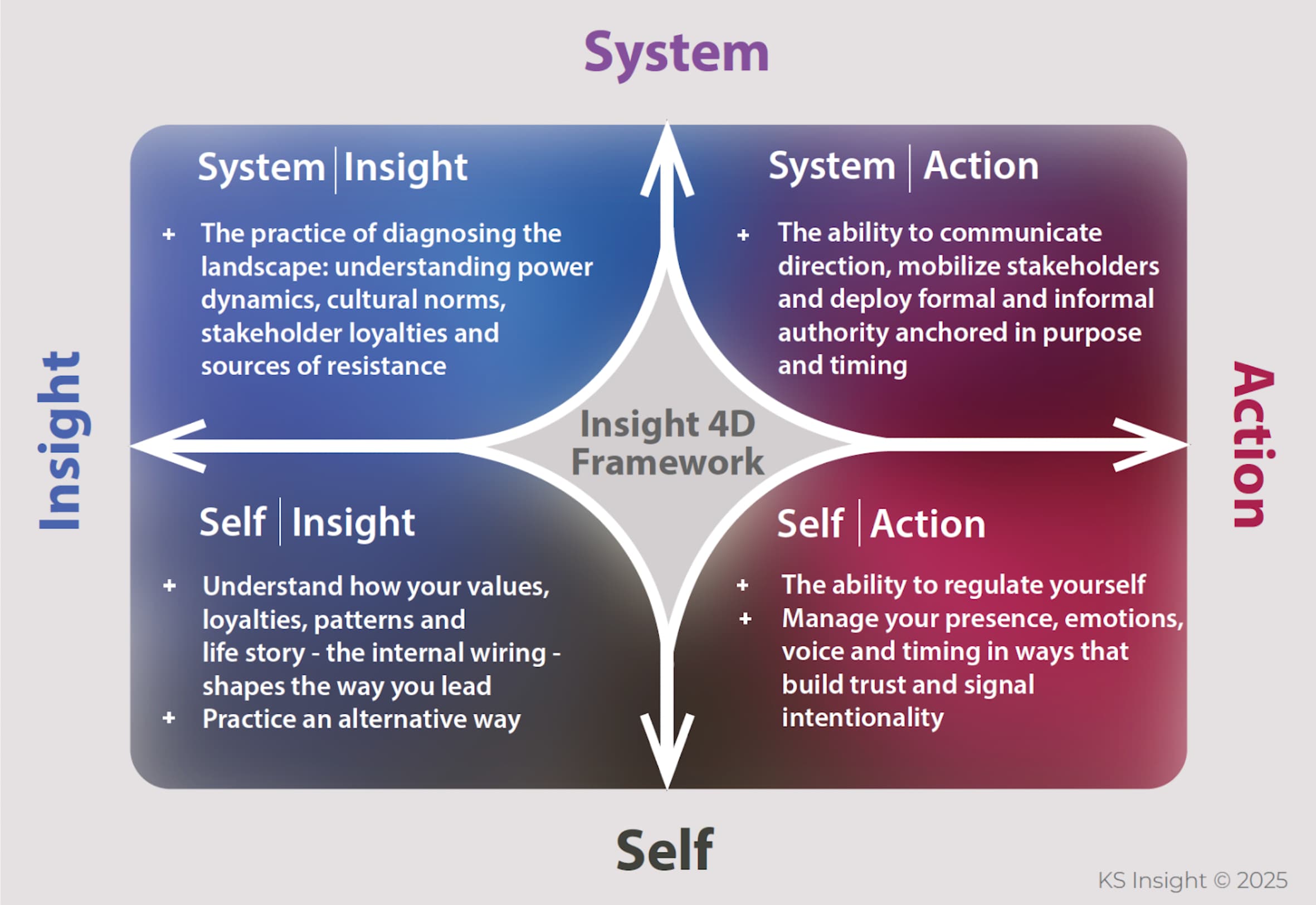
The Four Dimensions
1. Self Insight
How your past, your identity, and your instincts shape the way you lead
This dimension is about the patterns that drive you under pressure:
- how you read a threat or a challenge
- how you react when your status, your skill, or your sense of belonging feels shaky
- which loyalties and values steer your choices
- which stories from past roles still shape how you respond now
- where you reach for control, certainty, or retreat
Many leadership failures start long before the visible decision. They start in how the leader reads the situation.
Two leaders can walk into the same meeting and see completely different realities. One sees a challenge and a debate. The other feels shaken and under threat. One finds the uncertainty interesting. The other feels they are losing control.
These readings matter. They decide what each leader can hear, sit with, and do next.
Weak Self Insight can look like certainty from the outside. Consider someone who confidently sizes up everyone else in the room, but cannot see how their own history shapes that judgment. Think of the CFO who treats every disagreement as a test of her competence. She spent twenty years proving she belonged in the room. Or think of the founder whose urgency looks like vision from the outside. Inside, it is driven by a fear that slowing down will expose him as weak or irrelevant.
The hard part is that these patterns worked somewhere. They helped the person succeed. They protected them. They won authority, standing, promotion, or plain survival.
So Self Insight is more than awareness. Strengthening Self Insight is uncomfortable work.
The most useful moments come when a leader sees a pattern they would rather not have. One CEO finally says: "I shut down disagreement because it reminds me of my first board." One senior executive sees that her heavy over-preparation is a way to manage her fear of being undermined in public. One leader finds that what they call "high standards" is sometimes fear of losing authority.
Without Self Insight, a leader treats their reactions as fact. With it, they start to see that their read of the system is always shaped, in part, by the system inside them.
2. Self Action
Your ability to manage how you show up, in the moment
These are practiced skills that decide whether you hold steady under pressure:
- pacing what you say
- using silence on purpose
- controlling your tone, timing, and energy
- asking good questions when the pressure is on
- showing steadiness when others become reactive
- being clear without shutting people down
The leaders who struggle most are often the ones whose insight vanishes the moment their body speeds up.
They read the room well. They know what the moment needs. Then pressure hits. Their voice tightens. They talk faster. They listen less. Their need for certainty pushes out their curiosity. The room stops seeing them as steady. It starts to see them as anxious, controlling, or defensive.
This happens all the time.
A leader means to stay open when challenged. The moment someone disagrees, they start interrupting. A senior executive wants to look steady during a period of change. Their fast pace signals alarm instead. A dean asks for honest disagreement. Then, without meaning to, they punish the first person who offers it.
People forget how fast a group reads the body. Humans are always reading signals:
- Is this person steady?
- Is this person defensive?
- Can disagreement survive around them?
- Do they tense up under pressure?
- Are they calming the room or feeding its anxiety?
Self Action can be built.
Leaders who get better at it improve the same way. They repeat it. They get seen. They get feedback. They practice under stress they can handle. They learn to notice their body speeding up sooner. They learn to slow down on purpose. They build a tolerance for silence. They stay connected to people while under challenge. They keep thinking even when their emotions are firing.
Over time, the gap between what they know and what they can actually do gets smaller.
3. System Insight
Seeing the human system and understanding how it operates
This dimension is the steady practice of reading at the system level, noticing:
- where trust is strong and where it is fraying
- what losses are driving resistance
- how culture, identity, and informal authority shape behavior
- what people keep quiet
- which loyalties set the timing of decisions
- where power really sits, on the org chart and off it
System Insight gives a leader a more accurate map of what is driving group behavior.
Most organizations hold several realities at once. The same decision looks very different depending on where you sit. A restructure feels necessary to executive leaders. It feels destabilizing to middle managers. An efficiency drive feels responsible to finance. It feels like it takes from operations. A push for innovation excites one group. It threatens another.
A common failure I see here is leaders treating a structural conflict as a personal one. The CEO says the CFO and the CMO just cannot work together. Meetings are tense. Coaches come in. Offsites are held. One of the two is quietly being lined up for replacement.
The system view tells a different story. The CFO owns financial discipline, risk, and how capital is used. The CMO owns growth and winning customers. The structure itself creates opposing pressures. Replace one of them and the same conflict comes back, with a new face in the role.
Strong System Insight reads past the visible behavior to the conditions behind it. It asks a few questions. What incentives are driving these reactions? What losses are people protecting? What tensions over authority are built into the structure? In this system, what can people no longer say openly without paying a price?
4. System Action
Taking action to shape the system and influence at the group level
These are deliberate moves a leader makes to help a group move forward. They may operate on the structural level or the group dynamics level:
- setting clear decision rights
- ordering the conversation on purpose
- pacing change so people can absorb it
- setting direction with calm and clarity
- naming the unspoken dynamics that block progress
- bringing the right people together with the right level of heat
One of the hardest parts of System Action is that real movement upsets the current balance. Once you clarify authority, some people lose influence. Once conflict can be discussed, political cover weakens. Once incentives change, loyalties shift. Once things get clearer, people can no longer avoid accountability. Every one of these shifts is a loss for someone. People protect what they are about to lose - influence, status, a familiar role. That protection is what we see as resistance.
What separates effective System Action is the ability to address multiple levels at once: structure and group dynamics. It takes strong group facilitation skills.
How the Dimensions Interact
Effective leadership often requires capacity in all four quadrants.
A leader can read a system well and still get defensive when challenged (weak Self Insight). Another can manage their presence well and still miss a crack in the culture (weak System Insight). Another can pace a conversation well and still fail to hold the tension it brings up (weak Self Action). The four dimensions depend on each other.
A Worked Example: When Insight 4D Produces a Different Diagnosis
A CEO calls about a senior team in conflict. The CFO and CMO openly undermine each other. Meetings keep getting tenser. Big decisions stall. The CEO is worn out. Two coaches have already been in. An offsite ran six months ago. Nothing really changed.
Without a system lens, the usual reading is personal: difficult personalities, poor communication, clashing styles, low trust. And the usual fix is more coaching.
Run the four dimensions instead.
Self Insight (the CEO). What is the CEO missing about her own role? She had been avoiding the bigger conflict that sat above the two executives. She saw her own avoidance as patience and as trusting her people. The executives saw it as being abandoned. She had pushed the job of joining up strategy down onto two roles that were built to compete.
Self Action (the CEO). What does she actually do when the conflict heats up? She avoids it. She kept moving the integration question off the agenda. Raising it would mean admitting her own part in the problem. Meetings stayed on operations because a strategic showdown raised her own anxiety.
System Insight (the system). What is the structure producing? It produces an unstable setup. The incentives compete. No one shares accountability. No one has clear authority to join things up. Big decisions need collaboration, but nothing supports it. The system itself was creating the conflict between peers.
System Action (the intervention). The intervention works on two levels. Structural: clarify who has authority to join things up. Restructure the incentives so both leaders succeed together. Change how issues escalate. Re-sequence big decisions so unresolved tensions rise upward instead of staying stuck between peers. Group dynamics: run the sessions where the competing pressures get said out loud. Surface the gap the CEO had left open. Hold the room while the two executives build shared accountability. This second level takes real facilitation skill.
The "personality conflict" fades because the organization stopped asking two people to quietly absorb tensions the structure created. The individuals stayed the same. What changed was the conditions behind the friction. That is what Insight 4D helps you see.
How We Use Insight 4D to Build Developmental Maps
Insight 4D gives us a structure to build practical development maps. We use it across roles, sectors, and leadership challenges.
For any skill - building trust, pacing change, building a coalition, making decisions - the framework helps us name:
- the common patterns that derail leaders
- the system dynamics that keep those patterns in place
- the small skills needed to make progress
- the specific shifts that unlock movement
What Insight 4D Offers Leaders
Insight 4D gives leaders:
- a way to understand why they get stuck in the same patterns
- a structure for seeing themselves and the system clearly
- a clearer picture of what actually has to change
- a development path built around real leadership challenges
- range - using the move a moment needs, even when your instinct pulls the other way
The Insight 4D Framework also sits at the center of our Women Igniting Leadership Lab. There we use it through the Insight 360 Evaluation and the Insight Leadership Skill Assessment to help women leaders map and grow their range.
Frequently Asked Questions
What is the Insight 4D Framework?
Insight 4D sorts leadership into four connected dimensions: Self Insight, Self Action, System Insight, and System Action. Together they describe the capacities a leader needs when the environment is shaped by uncertainty, competing loyalties, tension over authority, and organizational complexity.
Why four dimensions?
Because under pressure a leader has to manage two systems at once: the one inside them and the one around them. Frameworks that focus only on self-awareness tend to underplay structure and power. Frameworks that focus only on systems and strategy tend to underplay the body, identity, and self-control. In real life, leadership failures usually come from the way these dimensions interact.
How is Insight 4D different from adaptive leadership?
The adaptive leadership tradition from Ronald Heifetz helps leaders tell technical challenges apart from adaptive ones and explores the self as a system. Insight 4D picks up after that diagnosis. It focuses on what a leader then needs to be able to do. The two fit together. Adaptive leadership strengthens diagnostic capacity. Insight 4D incorporates that diagnostic clarity and extends the model to help build the capacity to take action in relation to the self and system.
Who is Insight 4D for?
Insight 4D is for leaders in situations where the old playbook no longer works: innovation, fast growth, organizational change, leadership succession, conflict across functions, a fracturing culture, low trust in the institution, and systems under strain. The framework also sits at the center of our Women Igniting Leadership Lab and shapes both the Insight 360 Evaluation and the Insight Leadership Skill Assessment.
What does development across the four dimensions actually look like?
It rarely runs in a straight line. Most leaders start with some dimensions much stronger than others. The work is to build range where the same weakness keeps showing up under pressure, while keeping the strengths the leader already has. It usually happens in cycles: diagnosing, practicing, reflecting, experimenting, and adapting under real conditions.
Where Insight 4D Came From
Insight 4D grew out of more than fifteen years of work with senior leaders. That work spanned geopolitical conflict zones and complex organizations.
The framework draws heavily on the adaptive leadership tradition built by Ronald Heifetz and his colleagues at Harvard's Kennedy School. Heifetz has been a long-standing collaborator with KS Insight across more than a decade of work together on leadership development.
Adaptive leadership helps diagnose the challenge. Insight 4D focuses on what a leader needs to act on that diagnosis in a real organization. It became necessary for a simple reason. Many leaders grasped the adaptive ideas in their heads, but still struggled in their behavior and with the system once the pressure rose. Insight 4D tries to make those missing dimensions visible.