
Home/ Resources/ Thought Leadership

Thought Leadership

Thought Leadership - KS Insight
White Paper Cover

How the Legal Industry's Digital Evolution Illuminates the AI Challenge

This research paper examines how three decades of digitization reshaped the legal industry - rewiring work, client expectations, staffing models, and firm economics - and why some of the most respected firms collapsed while others adapted and thrived. By analyzing multiple waves of disruption, it reveals that survival depended less on technology and process than on leaders' diagnostic clarity and cultural choices. The paper argues that the legal sector offers a rare long-horizon analogue for today's AI transition, showing how substitution pressures expose organizational brittleness, identity risks, and the consequences of misaligned leadership responses.

Focus areas
  • How digitization systematically reshaped knowledge work, client dynamics, and firm economics.
  • Why four firms collapsed while others preserved focus, scaled, or reinvented delivery models.
  • Six leadership lessons on adaptation, trust, culture, training, and diagnostic discipline - and how they translate to the accelerated AI era.
White Paper Cover

The Leadership Challenge Framework: Mapping Uncertainty and Urgency

This piece introduces a two-axis diagnostic model that helps leaders decide what kind of work they are in before they act and explains how different combinations of uncertainty and urgency require different leadership responses.

Focus areas
  • Distinguishing between expert delivery, expert response, adaptive work, and fog-zone conditions.
  • Recognizing frequent misdiagnoses that lead to stalled change or overconfident crisis handling.
  • Using a shared framework to align leadership teams on the nature of the problem before debating strategy.
White Paper Cover

The AI Substitution Spectrum: A Diagnostic Framework for Understanding Where AI Will Reshape Work

The AI Substitution Spectrum helps leaders evaluate which components of work are most exposed to AI-driven change and which require human judgment, contextual understanding, or legitimacy. It clarifies how the locus of value shifts when technical production becomes inexpensive, fast, and widely accessible.

Focus areas
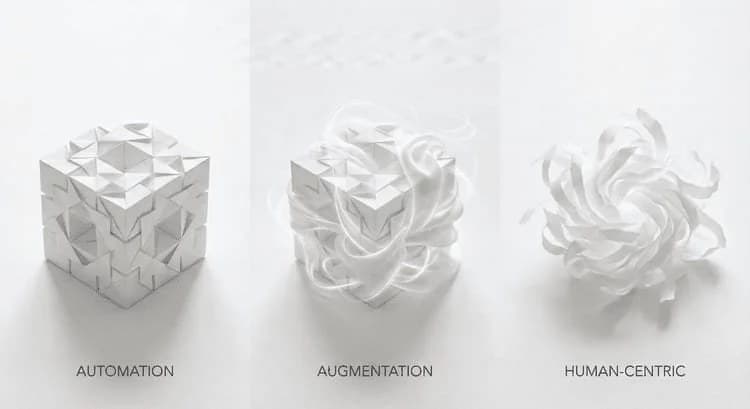
  • Mapping tasks across three levels: high substitution (rule-governed), moderate substitution (curation and synthesis), and low substitution (judgment and accountability).
  • Understanding the collapse of the technical production bottleneck and the shift from production-constrained to evaluation-constrained organizations.
  • Using the spectrum as a diagnostic for role redesign, not job classification - most roles span all three levels.
White Paper Cover

The FOG FILTER: Leading in High-Uncertainty, High-Urgency Conditions

The FOG FILTER provides a two-stage logic for acting in high-urgency, high-uncertainty conditions, helping leaders stabilize systems, evaluate potential moves, and avoid both paralysis and reckless bets.

Focus areas
  • Using Frame-Orient-Triage to create enough order for thoughtful action.
  • Applying the FILTER test to assess speed, learning value, trust impact, and reversibility.
  • Turning a series of imperfect moves into a coherent learning process under fog conditions.
White Paper Cover

Insight 4D Framework: From Insight to Action

Insight 4D organizes leadership practice into four dimensions - Self Insight, Self Action, System Insight, and System Action - to connect self-awareness, systemic understanding, and in-the-moment intervention.

Focus areas
  • Understanding how leaders can overdevelop one dimension at the expense of others.
  • Translating insight into concrete behavioral shifts in high-pressure moments.
  • Using the framework to design practice that builds range across all four quadrants.
White Paper Cover

The 4As Journey: A Map for Practicing Leadership

The 4As Journey - Awareness, Ask, Act, Adapt - describes a repeatable development cycle for turning leadership concepts into practiced, reliable behavior.

Focus areas
  • Noticing default patterns under pressure as the foundation for change.
  • Using feedback and experimentation to test and refine new behaviors.
  • Building habits through structured reflection rather than one-off efforts.
White Paper Cover

Why Leadership Is So Difficult to Learn - and Teach

This article explores why leadership development often stalls when it focuses on traits or inspiration alone and makes the case for treating leadership as observable, practicable behavior.

Focus areas
  • Distinguishing mindset from behavior and why both must be developed together.
  • Breaking complex capabilities into specific moves, questions, and routines.
  • Using experiential methods, Insight 4D, and the 4As to structure real practice and feedback.
White Paper Cover

Technical vs. Adaptive Challenges: Are You Solving the Right Problem?

This note revisits the distinction between technical and adaptive challenges and highlights how misclassification leads to repeated, ineffective solutions and rising frustration.

Focus areas
  • Distinguishing problems solvable by expertise from those requiring shifts in values and behavior.
  • Spotting common missteps when leaders apply the wrong type of solution.
  • Linking this distinction to the wider leadership challenge and fog frameworks.

Leading Through the AI Revolution: Diagnosing and Acting in the Fog

"AI is changing the nature of work, but the real failure point is leaders misreading the kind of disruption they are in."

Overview

This paper argues that AI is less a neutral "tech trend" and more a substitution shock for knowledge industries: work that once defined professional expertise is being stripped, accelerated, or handed to machines on a compressed timeline. Drawing on research on the digitization of the legal sector, this paper shows that firms did not rise or fall based on tools alone, but on how accurately leaders diagnosed the kind of challenge they faced and aligned culture and strategy to match.

The paper first distinguishes four zones of work using the Leadership Challenge Framework (Expert Delivery, Expert Response, Adaptive Challenge, Fog Zone), then locates AI primarily as adaptive work with a strong fog overlay: leaders must hold pressure and ambiguity at once. The AI Substitution Spectrum is then used to map how different categories of work shift as AI moves from automating routine tasks to collaborating on analysis to leaving judgment- and trust-based work at the top.

Key Themes

Rather than treating AI as a single strategic problem, the paper encourages leaders to disaggregate where substitution is highest, where hybrid human-machine work will emerge, and where uniquely human value will remain. It shows how common leadership errors - overinvesting in tools, underinvesting in identity and culture, and clinging to old definitions of expertise - tend to show up in each zone.

The FOG FILTER is then introduced as a disciplined way to act in high-urgency, high-uncertainty conditions: frame and stabilize, orient stakeholders, triage what matters most, then test each move for speed, learning value, impact on trust, and reversibility. Together, the three frameworks become a practical toolkit rather than a set of abstract models.

Implications for Leaders

The paper closes with a pragmatic flow for leading through the AI era: diagnose the zone of work before deciding, map exposure along the substitution spectrum, stabilize the system and communicate honestly about what is unknown, and then lead the adaptive work on identity, roles, and culture. It advocates for small, reversible experiments over large bets, emphasizing that long-term resilience depends on diagnostic clarity, emotional steadiness, and the capacity to keep learning in the fog.

The Leadership Challenge Framework: Mapping Uncertainty and Urgency

"Before leaders act, they must know what kind of work they are in."

Overview

This piece sets out a simple but demanding discipline: before deciding how to lead, name what kind of work you are in. It maps challenges against two axes - uncertainty (how clear is the problem and the path?) and urgency (how much time is there?) - and shows how that produces four different leadership zones with distinct demands.

Expert Delivery covers complex but predictable work where planning, expertise, and coordination dominate. Expert Response is the realm of rehearsed emergencies where the solution is known but time is short. Adaptive Challenges sit in high-uncertainty, lower-urgency terrain, where the work is to help the system learn and absorb loss. The Fog Zone combines high urgency and high uncertainty, where leaders must move without clear answers.

Key Themes

The paper surfaces common misdiagnoses: treating adaptive work like expert delivery ("just implement the plan"), or treating fog like a normal crisis and overconfidently declaring a solution. It shows how these errors lead to stalled change, repeated initiatives that never stick, or reputational damage when leaders promise more certainty than they actually have.

It then offers concrete questions leaders can use to classify a situation: Who actually knows what to do? How much time is available before consequences worsen? What kind of loss or change in values might be required for progress? The framework is presented as a shared lens for executive teams to use before locking in a course of action.

Implications for Leaders

Used well, the Leadership Challenge Framework helps leaders and their teams argue less about tactics and more about whether they are, in fact, solving the right category of problem. It encourages a pause for diagnosis before commitment and invites leaders to shift their posture - expert, facilitative, experimental, or stabilizing - based on the work itself rather than habit or preference.

The AI Substitution Spectrum: A Diagnostic Framework for Understanding Where AI Will Reshape Work

"The question is not whether AI can 'do the work,' but which parts of the work it substitutes for - and which parts become more central to human expertise."

Overview

The AI Substitution Spectrum provides leaders with a practical framework to evaluate which components of work are most exposed to AI-driven change, and which require human judgment, contextual understanding, or legitimacy. It does not predict job loss. It clarifies how the locus of value shifts when the technical layer of work becomes inexpensive, fast, and widely accessible.

The Three Levels

Level 1 (High Substitution) covers rule-governed, pattern-based tasks where value historically came from technical skill or processing large amounts of information. Data cleaning, structured drafting, first-pass analysis - AI already performs these reliably and fast.

Level 2 (Moderate Substitution) includes work requiring curation, synthesis, and iterative assembly. AI generates abundant options; humans provide coherence - sifting through technically competent outputs to identify what is relevant and contextually accurate.

Level 3 (Low Substitution) contains tasks requiring judgment, sensemaking, legitimacy, and accountability. Interpreting ambiguity, weighing competing priorities, navigating relational dynamics, taking responsibility for decisions. AI can contribute information but cannot assume legitimacy for outcomes.

The Core Insight

The most significant system-level change is the collapse of the technical production bottleneck. Previously, ideas were cheap but execution was expensive and slow. Now AI enables near-instantaneous generation of technically competent work. Organizations shift from production-constrained to evaluation-constrained - the bottleneck becomes human capacity to review abundant options and exercise discernment.

Implications for Leaders

The Spectrum is a diagnostic for understanding where value is shifting within roles - not a classification system for jobs. Most roles span all three levels. Leaders should map where value is shifting, redesign workflows so technical execution isn't the anchor, and invest in evaluation capability and judgment. The critical question the framework surfaces: if the work that once built judgment disappears, how will the next generation develop the expertise to exercise it?

The FOG FILTER: Leading in High-Uncertainty, High-Urgency Conditions

"Fog-zone leadership demands motion without illusion."

Overview

This paper focuses on the hardest quadrant of the Leadership Challenge Framework - the Fog Zone - where leaders face high stakes, limited time, and incomplete information. In these conditions there is no reassuring playbook, yet inaction or panic can both be costly.

To address this, the paper presents the FOG FILTER, a two-stage decision logic that helps leaders stabilize their systems, take steps that are useful even if they are not perfect, and avoid collapsing toward either paralysis or reckless bets.

Key Themes

Stage 1 (Frame-Orient-Triage) is about containment: framing what is known and unknown, orienting stakeholders to reduce rumor and fragmentation, and triaging which risks or failures must be addressed first to keep the system viable. Stage 2 (the FILTER test) evaluates candidate actions along six dimensions: whether speed is needed, whether inaction is worse, whether the move generates learning, how it will affect trust, whether it enables future options, and how reversible it is.

Through examples, the paper shows how this logic can be applied repeatedly to navigate a crisis as it unfolds, rather than betting everything on a single grand plan drafted in the dark.

Implications for Leaders

For leaders in fog conditions, the FOG FILTER provides a disciplined way to move while staying honest about uncertainty. It encourages designs that keep options open, protect trust, and generate information with each step, turning a forced series of imperfect moves into a coherent learning process rather than a string of isolated reactions.

Insight 4D Framework: From Insight to Action

"Insight only matters when it reliably shifts behavior under pressure."

Overview

This piece addresses a recurring problem in leadership development: people gain insight about themselves or their systems, but that awareness does not reliably translate into different behavior when it matters. Insight 4D offers a four-quadrant map to keep attention on both inner and outer work.

The quadrants - Self Insight, Self Action, System Insight, and System Action - distinguish between understanding personal patterns, regulating oneself in the moment, reading group dynamics, and intervening in the system.

Key Themes

The paper shows how leaders can overdevelop one quadrant (often Self Insight) while neglecting the others, leaving them reflective but not more effective in the heat of real situations. It uses examples from practice - such as learning to pause, shift posture, and ask a question instead of reacting defensively - to illustrate Self Action in context.

System Insight and System Action are illustrated through attention to silence, alliances, and shifts in "temperature" in the room, paired with interventions like naming a tension, changing the format, or inviting additional voices into a conversation.

Implications for Leaders

For practitioners, Insight 4D becomes a checklist and design tool: are all four dimensions being developed, or is one being overused? The framework is used to structure exercises, reflections, and feedback so that new patterns are deliberately trained across all quadrants until they are available under stress, not only in calm reflection.

The 4As Journey: A Map for Practicing Leadership

"Leadership grows through cycles of testing, feedback, and adjustment - not one-time breakthroughs."

Overview

The 4As - Awareness, Ask, Act, Adapt - describe a cycle for turning leadership concepts into repeatable practice. This note explains why each stage is necessary and what tends to go wrong when one is skipped.

Awareness is about noticing default responses, especially under pressure. Ask is about making that awareness social and testable by seeking specific feedback and checking interpretations with others.

Key Themes

Act focuses on small, concrete experiments rather than dramatic reinventions: trying a different behavior in a meeting, changing how a predictable trigger is handled, or delegating a decision usually held. Adapt is where those experiments are examined and refined so they gradually become reliable habits rather than one-off efforts.

The note shows how skipping Ask leaves leaders trapped in their own interpretations, and skipping Adapt means that even courageous acts never accumulate into meaningful development.

Implications for Leaders

For designers of leadership programs and for leaders themselves, the 4As provide a simple structure for building deliberate practice into daily work. They underpin leadership labs and simulations where participants loop through 4A cycles repeatedly, each time building more range, accuracy, and steadiness.

Not Every Crisis Has a Playbook: Lessons from the Fog Zone

"Some crises reward expertise; others require leaders to learn while acting."

Overview

Using the 2010 Chilean mine collapse as a central case, this piece illustrates the difference between crises that can be handled through rehearsed responses and those that belong in the Fog Zone, where neither time nor solutions are readily available.

It contrasts the mine case with more familiar expert emergencies such as paramedic or firefighting responses, where the key is rapid execution of a known protocol rather than invention under pressure.

Key Themes

The paper shows how the mine rescue combined high urgency, high public visibility, and deep technical uncertainty, forcing decision makers to make a series of partial bets, bring in outside expertise, and manage families and media in full view. A personal example of a child's health emergency is used to highlight the different feel of a crisis where experts do know the playbook.

From this, the paper distills what can realistically be trained before a fog-zone event: diagnostic discipline (recognizing fog instead of treating it as a standard crisis), the capacity to regulate anxiety, and the habit of designing reversible experiments under pressure.

Implications for Leaders

The essay links these lessons back to the broader leadership challenge and fog frameworks, suggesting that how leaders design learning, practice, and decision forums in normal times will shape how effectively they can act when there is no ready-made plan.

Lead Anyway: Leadership in Uncertain Times

"In deep uncertainty, leadership is less about certainty and more about motion, honesty, and collective steadiness."

Overview

Written in a period when many leaders described the moment as the hardest they had ever led through, this essay looks at what it means to lead when funding, jobs, and institutional structures all feel unstable. The central tension is how to act with integrity when outcomes cannot be guaranteed for the people who look to leadership for security.

Key Themes

The essay distills three core moves. "Don't turtle" pushes against the instinct to withdraw and wait for clarity, arguing instead for visible motion through small bets and active scanning. "Stay in conversation" emphasizes naming what is known and unknown, sharing experience from previous crises, and allowing people to voice their concerns. "Learn in motion" borrows from FDR's call for "bold, persistent experimentation," treating strategies and initiatives as trials that can be adjusted.

Throughout, the piece shows how leaders can be transparent without creating panic and how acknowledging limits can strengthen rather than weaken trust when done with care.

Implications for Leaders

The essay positions uncertainty not as a one-time problem to solve but as a recurring condition to navigate with honesty and discipline. Leaders who keep their teams moving, thinking, and in relationship with reality - rather than retreating into silence or false assurance - are more likely to sustain performance and cohesion through volatile periods.

The Best Way to Lose Morale? Leave People Out.

"People can tolerate hard news; they lose trust when they feel excluded."

Overview

This piece starts from a familiar scenario: a capable team facing budget cuts, structural change, or uncertain funding. Leaders, worried about causing distress, withhold information or centralize decisions only to see morale erode anyway. The argument is that, in these environments, exclusion and silence do more damage than honest bad news because they undermine people's sense of dignity and agency.

Key Themes

The essay breaks morale into four elements - trust, meaning, dignity, and connection - and shows how each is affected when people feel left out of conversations that shape their future. It offers practical moves: naming uncertainty aloud, clarifying what is within and beyond everyone's control, and making time for one-to-one connection rather than relying solely on generic broadcast updates.

The concept of "micro-dignity" runs through the piece: small, consistent acts of acknowledgment, transparency, and follow-through that signal people have not been reduced to roles or headcount.

Implications for Leaders

For leaders navigating hard decisions, the paper suggests including people in honest, bounded ways - sharing decision criteria, inviting input on trade-offs, and explaining the reasoning behind outcomes - to help sustain morale even when outcomes are not what people hoped. It reframes morale as less about cheerfulness and more about whether people feel respected, informed, and part of a real effort to respond well.

Why Leadership Is So Difficult to Learn - and Teach

"Leadership becomes learnable when it is broken into observable moves, not abstract traits."

Overview

This article tackles a basic but often ignored problem: leadership is hard to define, fragmented across schools of thought, and heavily context-dependent, which makes it hard to learn and even harder to teach. It argues that a more effective approach is to treat leadership as a craft of observable behavior rather than as a set of traits or inspirational themes.

Key Themes

The piece distinguishes between mindset (how leaders think about role, power, and people) and skills (what they actually do and decide). It explains how focusing on only one of these leads either to insight without action or to technique without judgment. It then shows what it means to "make leadership observable," breaking complex ideas like emotional regulation or strategic thinking into specific questions, routines, and physical or verbal moves that can be practiced.

It describes experiential learning structures where the group becomes the case: participants experiment in real time, see how their actions shift dynamics, and loop through reflection and re-try. The Insight 4D framework and the 4As Journey provide scaffolding for this kind of practice.

Implications for Leaders

The article concludes that leadership development is fundamentally developmental rather than informational: it requires repeated exposure to "heat," structured practice, honest feedback, and safe-enough containers to examine one's own impact. It invites organizations to shift away from content-heavy, practice-light programs and toward formats that allow leaders to build real skill under realistic conditions.

Active Listening Techniques: A 4-Part Framework for Leaders

"The costliest mistakes are often not about missing data, but about not really hearing what was already said."

Overview

This piece begins with the observation that many senior leaders have learned how to appear attentive while mentally moving on to other tasks. That habit is costly because it causes them to miss weak signals, misunderstand resistance, and make decisions on a thin slice of what their system is trying to communicate.

Key Themes

The framework has four parts. "Listen beyond words" focuses on reading the system: noticing who stays silent, which topics change the energy in the room, and how people's pacing and tone shift. "Ask generative questions" turns conversations from debate into shared diagnosis, using questions such as "What are we not talking about?" or "What would have to be true for this to work?"

"Regulate the noise" is about managing the leader's own reactivity - pausing before responding, noticing defensiveness, and resisting the urge to fix instantly so others can think. "Reflect, integrate, and act" centers on making listening visible by summarizing what was heard, naming which assumptions have changed, and adjusting plans in ways people can see.

Implications for Leaders

The paper positions listening as a strategic discipline rather than a soft skill: it allows leaders to spot patterns earlier, understand what is really blocking progress, and build trust through visible responsiveness. Relatively modest changes in how leaders listen and follow through can produce disproportionate improvements in team alignment and decision quality.

Technical vs. Adaptive Challenges: Are You Solving the Right Problem?

"Faster execution doesn't fix the wrong kind of problem."

Overview

This note returns to a central distinction from adaptive leadership: some problems can be solved with existing expertise and procedures, while others require people to change values, habits, or ways of working. Treating one as the other is a reliable way for leaders to get stuck.

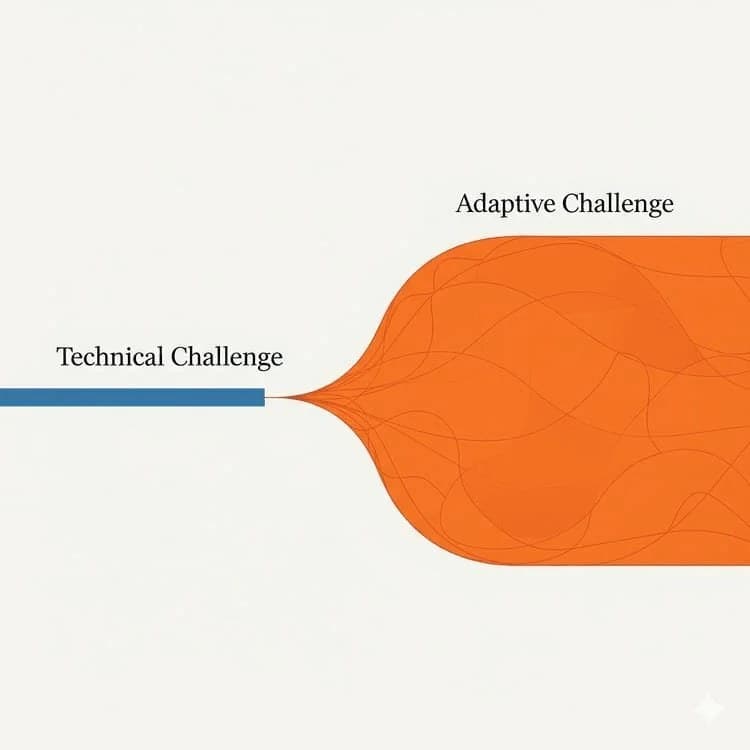
Technical challenges are those where the problem is clear and the solution is known or discoverable by experts. Adaptive challenges involve conflicting values, loss, or shifts in identity and cannot be resolved by technical fixes alone.

Key Themes

The paper highlights classic missteps: launching training or communication campaigns when the real issue is unspoken loss, political conflict, or competing definitions of success; or, conversely, convening endless dialogues when a straightforward process or system fix would address the immediate pain.

It offers practical diagnostic questions - where does the problem really live, who has the knowledge to address it, and what losses are implied by successful change - and shows how those answers help classify the work correctly.

Implications for Leaders

Finally, the note connects the technical/adaptive distinction to the broader leadership challenge and fog frameworks, underscoring that technical work tends to sit in expert zones, while adaptive and fog-zone work demand learning, loss, and tension-holding from leaders. It encourages leaders to stop doing "better and faster versions of the wrong thing" and to align their strategies with the actual nature of the challenges they face.