
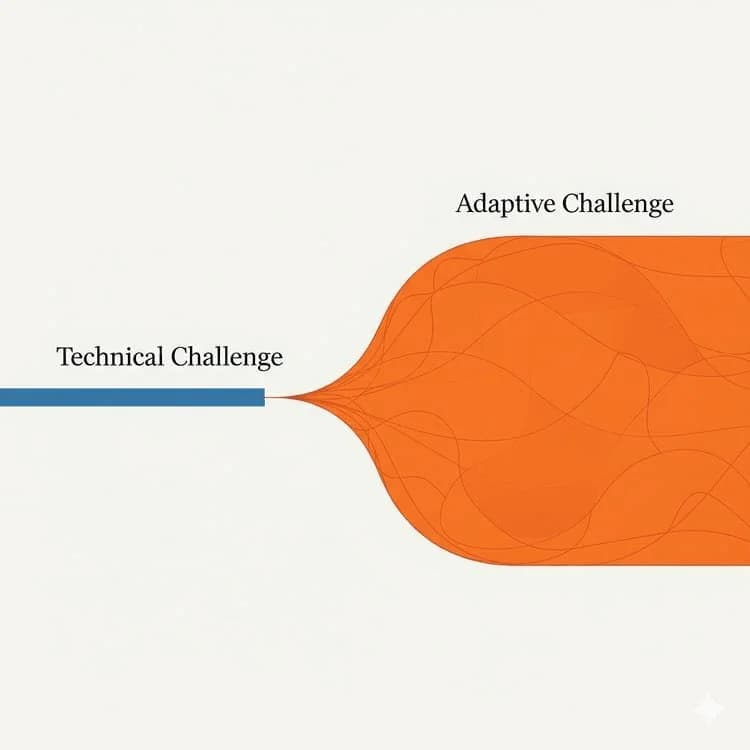
Most leadership failure is a failure of diagnosis.
Organizations routinely apply technical solutions to problems that are adaptive in nature because technical work feels concrete, measurable, and manageable. Adaptive work is slower. It surfaces conflict, competing loyalties, uncertainty, identity, loss, and questions that do not have a clean answer.
The distinction matters because organizations can spend years solving the wrong problem while convincing themselves they are making progress.
A company restructures repeatedly but trust continues to erode. A university launches a new strategic plan while internal factions deepen. A health system introduces a technically sound operating model that staff quietly resist. An executive team attends offsites, completes 360s, and participates in coaching, yet the same tensions continue to reappear.
The issue is often not effort.
The issue is that the organization has misdiagnosed the nature of the challenge.
A Way of Working
In our work, we begin with a set of orienting questions:
- What is actually happening here?
- What part of this challenge can be solved through expertise, process, or coordination?
- What part requires people to rethink assumptions, relationships, authority, or identity?
- Who benefits from the current system?
- Who bears the cost?
- What is at risk of being lost?
- What tensions are present but no longer discussable?
These are habits of attention.
The goal is not immediate action. The goal is accurate diagnosis.
That sounds deceptively simple. In practice, it is difficult because organizations are usually rewarded for momentum, decisiveness, and visible activity. Slowing down long enough to examine the nature of the challenge can feel, culturally and politically, like failure.
Especially in senior leadership environments, movement is often confused with competence.
A leader who quickly launches initiatives, restructures teams, commissions consultants, or introduces new systems is frequently perceived as decisive. A leader who pauses to ask whether the organization is solving the right problem can be perceived as hesitant or insufficiently action-oriented.
Many organizational failures are failures of interpretation.
The organization acts on the visible symptoms.
The Distinction I Learned in Conflict Zones
I learned the technical-adaptive distinction negotiating in places where the cost of misdiagnosis was measured in lives.
In Iraq, Somalia, and Sudan, the technical work was often relatively simple - drafting constitutional provisions, designing electoral systems, creating governance mechanisms capable of functioning on paper. There were experts for all of that: constitutional lawyers, political scientists, institutional designers, governance specialists.
The adaptive work was entirely different.
The adaptive work involved asking groups that had been in violent conflict to share authority, legitimacy, and political space. It involved fear, grief, humiliation, distrust, revenge, historical memory, and competing loyalties. It involved people confronting futures they did not want and losses they did not choose.
You cannot negotiate that through drafting alone.
Many peace processes fail because the adaptive challenge is treated as a technical one. A more sophisticated agreement is written. Better structures are designed. More elegant institutional arrangements are proposed. But the underlying adaptive work remains largely untouched.
The same dynamic appears constantly in organizations.
A merger is announced. The technical integration begins immediately: governance, reporting structures, technology systems, financial integration, operational alignment. Those are important tasks. But the adaptive challenge is whether people reinterpret loyalty, trust, authority, and identity inside the new organization.
People may formally agree to the merger while privately continuing to operate according to the previous system. Meetings become polite but factionalized. Information is withheld. Old alliances harden. Senior leaders interpret the problem as insufficient alignment when the deeper issue is unresolved loss and distrust.
The same thing happens during digital transformation initiatives.
Organizations often frame digital transformation as primarily a technical challenge requiring implementation roadmaps, new tools, and operational redesign. But many digital transformations fail because the adaptive challenge is not addressed. Leaders who built authority, expertise, and status within the previous operating model are now being asked to relinquish forms of competence that previously made them successful.
The resistance is not necessarily irrational.
In many cases, the organization is asking people to surrender identity, legitimacy, or accumulated authority while pretending the change is merely procedural.
Compensation redesigns reveal similar dynamics. A technically elegant compensation system can still fail if employees experience it as unfair, illegitimate, or disconnected from how value is actually created inside the organization.
The diagnostic question is always the same: where is the resistance actually located?
If the resistance sits primarily in coordination, information flow, technical capability, or process design, the challenge is largely technical.
If the resistance sits in legitimacy, identity, trust, loyalty, status, fear, or loss, the challenge is adaptive.
No amount of technical sophistication resolves an adaptive challenge that has not been recognized as such.
Why Adaptive Work Is Difficult
Adaptive work is difficult partly because it implicates the leader.
Technical work allows leaders to remain relatively unchanged while solving a problem externally. Adaptive work often requires leaders themselves to reconsider assumptions, authority relationships, habits, incentives, or interpretations they may be deeply invested in maintaining.
That is uncomfortable work.
As a result, organizations routinely default toward technical responses even when the underlying challenge is adaptive.
Common patterns include:
- escalating process when the issue is trust,
- increasing communication when the issue is legitimacy,
- restructuring teams when the issue is unresolved authority conflict,
- adding metrics when the issue is fear,
- accelerating timelines when the organization is already overwhelmed,
- or replacing individuals while leaving the system generating the conflict untouched.
Organizations also frequently misread conflict itself.
In adaptive work, conflict is often diagnostic information. It reveals where competing interpretations, loyalties, fears, or losses are sitting in the system. Attempts to prematurely smooth over tension often remove the very information leaders need in order to understand the challenge accurately.
This is one reason adaptive work frequently feels inefficient.
The organization wants resolution. Adaptive work often initially produces more visibility into disagreement, contradiction, or instability. Leaders can interpret this as evidence that the intervention is failing when in reality the organization may finally be surfacing dynamics that were previously suppressed.
In many organizations, adaptive avoidance becomes institutionalized.
The organization learns how to remain in motion without confronting the underlying challenge.
What Adaptive Avoidance Looks Like Inside Organizations
Adaptive avoidance rarely looks like inaction.
More often, it looks like intense activity organized around protecting the system from the implications of real change.
Organizations launch repeated restructures without addressing distrust. They produce communication campaigns when people no longer believe leadership interpretations of reality. They hold executive offsites where disagreement is carefully managed but never truly explored. They overproduce dashboards, metrics, and reporting structures because quantification feels safer than ambiguity.
The organization becomes increasingly performative.
Words like alignment, collaboration, innovation, and transformation circulate constantly while underlying tensions become progressively less discussable.
One of the most common forms of adaptive avoidance is personalizing structural problems.
An organization experiencing unresolved authority conflict begins focusing obsessively on a "difficult" executive. A executive leader becomes the container for tensions actually generated by the system itself. Replacing the individual may temporarily reduce pressure, but the underlying dynamics quickly reappear because the architecture producing them remains unchanged.
Another common pattern is mistaking urgency for effectiveness.
Adaptive work often requires slowing conversations down long enough for people to reinterpret what is happening. But organizations under pressure tend to accelerate. Leaders become anxious about appearing indecisive. Timelines tighten. Rollouts expand. More meetings are scheduled. More initiatives are launched.
The pace itself becomes a defense against reflection.
In these environments, people often stop saying what they actually think. The official conversation and the real conversation split apart. Public agreement increases while private skepticism deepens. Executive leaders interpret the absence of open resistance as alignment when it may actually reflect resignation, fear, exhaustion, or political calculation.
What is being discussed outside the room that is no longer discussable inside it?
One of the most important diagnostic questions in adaptive work is therefore: what is being discussed outside the room that is no longer discussable inside it?
The answer to that question often reveals the adaptive challenge more accurately than any strategic planning document.
Adaptive Leadership in Practice
Adaptive leadership is the capacity to remain in contact with what is actually happening in a system while helping people tolerate the uncertainty required for learning and change.
In practice, this often means slowing conversations down. It means resisting the pressure to prematurely resolve disagreement. It means listening underneath positions for the fears, loyalties, losses, and interpretations driving them.
Many leadership teams spend enormous energy trying to eliminate tension when the real task is understanding what the tension is revealing.
In adaptive situations, additional communication does not necessarily produce clarity. Sometimes it produces further polarization because different groups inside the organization are operating from fundamentally different interpretations of reality.
One group experiences a strategic shift as necessary modernization. Another experiences it as abandonment of institutional values. One group sees operational discipline. Another sees bureaucratic control. One group experiences speed as responsiveness. Another experiences it as destabilization.
Until those interpretations become discussable, organizations often remain trapped in repetitive cycles of frustration.
The turning point in adaptive work is frequently not a new strategy.
It is a shift in what people are finally able to examine openly together.
Adaptive Work Is Human Work
Adaptive challenges are ultimately human challenges.
Organizations often attempt to operationalize problems that are fundamentally about meaning, legitimacy, identity, status, or trust because operational problems feel safer and more controllable.
But underneath many stalled transformations sits a struggle over interpretation.
We worked with a global health organization that had technically implemented a new model of care successfully. The workflows existed. The metrics existed. The training had been completed. From a technical perspective, the implementation appeared sound.
Adoption still stalled.
Leadership initially interpreted the problem as insufficient compliance and execution. But the deeper issue was that clinicians experienced the new system as a diminishment of judgment and professional identity. Nurses felt increasingly proceduralized. Physicians felt expertise was being overridden by centralized standardization.
The organization interpreted resistance as implementation failure when it was actually a struggle over legitimacy and meaning.
Once those dynamics could be discussed directly, movement became possible.
That was because the organization finally addressed the adaptive dimension of the challenge.
Adaptive work frequently requires leaders to understand that people are responding to what is changing operationally. They are also responding to what the change means.
The Adaptive Leadership framework is also the foundation of our Women Igniting Leadership Lab, a 9-month program that helps women leaders develop the diagnostic and strategic capacities to navigate adaptive challenges in their own organizations.
For a practical tool to apply these concepts, see the Insight 4D Framework, which helps leaders diagnose the type of challenge they are facing and choose the right leadership response.
When a Personality Problem Is Actually a Role Problem
One of the most common misdiagnoses I see in organizations is interpersonalizing structural conflict.
A CEO says the CFO and CMO cannot work together. Meetings are tense. Each undermines the other. Coaching has not resolved it. Offsites have not resolved it. Communication workshops have not resolved it.
The technical diagnosis is that two difficult personalities are in conflict.
The adaptive diagnosis is that the organization has created structurally competing interpretations of success.
The CFO is accountable for financial discipline, risk, capital allocation, and operational stability. The CMO is accountable for growth, positioning, customer acquisition, and market expansion. Their tension is not necessarily dysfunction. In many organizations, the system itself is generating the conflict.
Both executives may be behaving rationally according to the authority structure surrounding them.
Replacing one executive often changes very little because the underlying architecture remains intact. The organization simply finds a new individual to occupy the same structurally conflicted role.
The adaptive work is therefore not simply improving the relationship between two people. It is examining how strategic integration, incentives, accountability, authority, and decision-making are organized across the system.
That work is significantly more uncomfortable for senior leadership because it requires examining the organization itself.
It may require the CEO to acknowledge that integration work has effectively been outsourced downward into unresolved executive conflict.
It may require changing incentive structures so leaders succeed collectively.
It may require confronting the fact that the organization itself sends contradictory signals about what constitutes success.
Those are adaptive questions.
And they are much harder than executive coaching.
Leading Through Adaptive Challenges
Leaders who work adaptively tend to share several characteristics.
They remain curious longer.
They tolerate ambiguity without rushing prematurely toward certainty.
They pay close attention to recurring patterns of avoidance, energy, conflict, and silence inside the system.
They understand that resistance is often information before it is obstruction.
Most importantly, they understand that adaptive progress rarely feels efficient while it is happening.
Organizations accustomed to technical problem-solving often become uncomfortable when adaptive work initially increases visible tension or uncertainty. But adaptive progress frequently begins with greater visibility into the system.
People start saying what they actually think. Conflicts previously managed politically become discussable. Misalignments become harder to ignore. The organization temporarily feels less stable because underlying tensions are no longer being contained in the same way.
Leaders often misinterpret this stage.
They assume the intervention is failing because the system feels more volatile. In reality, the organization may simply be becoming more honest.
Adaptive leadership requires enough steadiness to remain present during that phase without rushing to prematurely restore equilibrium.
Are You Solving the Right Problem?
Organizations regularly exhaust themselves applying technical solutions to adaptive challenges.
The result is a familiar pattern:
- repeated restructures that do not resolve distrust,
- new systems layered onto old authority conflicts,
- escalating communication around issues people still cannot safely discuss,
- strategic plans that stall despite broad formal agreement,
- leadership changes that leave the same tensions intact.
At some point, the question is no longer whether the organization is working hard enough.
The question is whether it has accurately diagnosed the nature of the challenge.
That requires asking different questions:
- What part of this problem is actually adaptive?
- Who would need to change in order for this to work?
- What losses are people trying to avoid?
- What loyalties or identities are being threatened?
- What conversations are occurring outside the room but not inside it?
- What would become destabilized if the organization truly addressed the issue directly?
These are difficult questions because they move leadership attention away from symptoms and toward systems.
Diagnosis is not separate from leadership.
In complex environments, diagnosis is leadership.
Common Questions About Technical vs. Adaptive Challenges
What is an adaptive challenge?
An adaptive challenge involves changes that cannot be resolved through expertise or procedural fixes alone. Adaptive challenges require people to rethink assumptions, relationships, loyalties, authority structures, habits, or identities that may previously have been functional or successful.
What is the difference between a technical and an adaptive challenge?
Technical challenges fit largely within existing systems and capabilities. They can usually be addressed through expertise, process improvement, coordination, or operational execution.
Adaptive challenges are different. They require learning, reinterpretation, and changes in how people understand both the problem and themselves inside it.
Why do organizations apply technical solutions to adaptive problems?
Technical work feels safer.
Technical responses produce visible activity, timelines, deliverables, and measurable progress. Adaptive work introduces ambiguity, conflict, uncertainty, and political risk. It also often requires executive leaders themselves to change, which many organizations unconsciously resist.
What does adaptive leadership look like in practice?
Adaptive leadership involves helping organizations remain in contact with reality long enough to learn.
That often means surfacing tensions, slowing conversations down, and treating resistance as diagnostic information.
How do I know if I am facing an adaptive challenge?
One indicator is repetition.
If the organization continues revisiting the same conflict despite restructures, leadership changes, communication efforts, coaching, or process redesigns, the underlying challenge may be adaptive rather than technical.
Another indicator is when the resistance appears tied to identity, legitimacy, trust, status, authority, or loss.
Where does the framework come from?
The technical-adaptive distinction was first articulated by Ronald Heifetz at Harvard's Kennedy School, who founded the field of Adaptive Leadership. Heifetz has been a longstanding collaborator with KS Insight - more than a decade of partnership on leadership development work. We have built on his framework in our practice with senior leaders navigating mergers, succession, public scrutiny, and other high-stakes change.
Conclusion
The distinction between technical and adaptive challenges is not theoretical. It changes how leaders interpret resistance, conflict, authority, speed, and organizational change itself.
Technical problems require expertise.
Adaptive challenges require people to reconsider assumptions, relationships, loyalties, and ways of working that may once have been successful.
Organizations frequently fail because they continue solving for the wrong layer of the problem.
The work of leadership is learning to tell the difference.
The canonical adaptive challenge is systems change leadership.