

Leadership Can Be Learned.
People talk about leadership as if it were destiny - something a few people are born with and the rest of us are going to make do without ever developing: the “natural leader,” the charismatic one, the kid that dominated the sports field and naturally will go on to be a leader of industry. I have heard even executive leaders shrug and say “I’m just not very good at that part”, referring to the leadership needed to navigate the complexity we find ourselves in right now, as if that was set in stone.
But, the born leader is a myth. It is a persistent myth - reinforced in all sorts of ways in our society, from the misuse of the term leadership in general parlance (our leaders are not leading we say), to an over-indexing on extroversion or dominance as an indication of leadership in children.
The good news is that leadership can absolutely be learned.
I learned that early in my career, long before I had language for any of this. I was working in conflict zones, often in rooms where tempers flared fast and without warning. I was young, a woman, foreign, and - in some cases - the only person without a direct stake in the dispute. When tensions turned toward me (even as a symbolic representative of an institution), everything in me wanted to shrink. Confrontation is not something I naturally enjoy.
But retreat wasn’t an option. Holding steady was the work.
And nothing about that steadiness was instinctive. I had to practice it. I learned to pause before responding. I learned to push my chair back a few inches to give myself physical space. And I learned that if I began with a question - “I’m listening, can you help me understand…” - the room shifted. The temperature dropped enough for people to find their words. And for me to find mine.
There was nothing “natural” about this. It was built, rehearsed, tested in heat.
And once I saw that leadership could be built, I started to notice something else: most people never get the chance to practice leadership in conditions that resemble the ones they actually face. Which is why so many leadership programs leave people inspired but unchanged.
This is the context in which all the confusion about leadership sits. And to understand why the “natural leader” myth survives, you have to start with the fact that leadership has never had a settled definition.
Why leadership feels so hard to define
Unlike writing or public speaking, where industries have settled on benchmarks for quality, leadership defies easy definition. Ask ten executives what makes a good leader, and you’ll get ten different answers. Even the scholars disagree - the field is fragmented, ambiguous, and constantly shifting. For those trying to grow as leaders, this creates a core problem: how do you learn something that no one can agree how to define?
This ambiguity creates a learning barrier. Most people learn best through practice - but how do you practice something that feels intangible? Traditional leadership development often feels abstract: full of inspirational ideas but light on usable tools.
The myth of the “born leader” persists in part because it offers a tidy shortcut around this complexity. But the deeper reason is historical.
Why the “natural leader” myth hangs on
The field itself evolved in ways that reinforced the idea.
1840s - 1960s - The Industrial Era
Leadership was defined as: Who gets to be in charge?
Traits. Hierarchy. Command. The idea that leaders were somehow different.
1960s - 1990s - The Management Era
The focus shifted to: How should leaders behave?
Situational leadership. Managerial competence. Vision and influence.
1990s - 2010s - The Knowledge Era
The core question became: Why do people follow?
Authenticity. Values. Self-awareness. Trust.
2010s - now - The Complexity Era
The question now: How do we make progress when no one has full authority and the problem does not sit still?
Competing loyalties. Distributed authority. Cultural complexity. Political pressure. Uncertainty.
This is the first era where it is unmistakably clear that leadership must be developed.
Leadership operates on two levels at once
Once you accept that leadership can be learned, you are still faced with a complex challenge: how do you teach it? One reason it’s hard is that leadership happens on two levels:
Mindset - how leaders think about their role, their people, their power.
Skills - the visible behaviors and decisions that mindset drives.
Leadership skills like psychological safetyare difficult to measure, but they change everything about how teams perform - even if they aren’t captured in simple metrics.
Making leadership learnable
Since leadership is complex and hard to measure, the answer is not to give up - it’s to make leadership observable, learnable, practicable.
And this is what we have done. Most meaningful leadership capabilities can be broken down into specific moves: behaviors, questions, routines. To learn them requires knowing what matters and how to change.
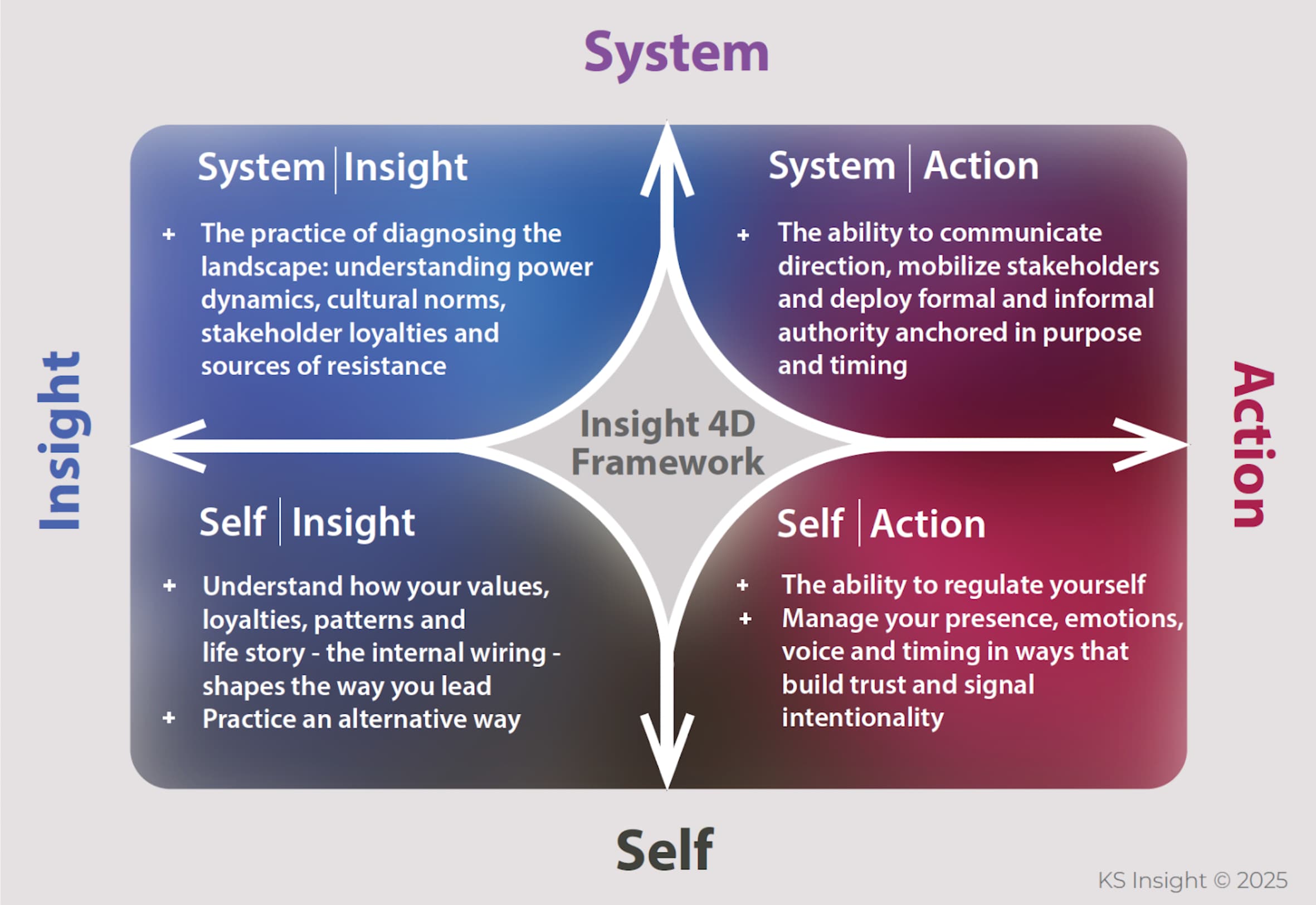
This is where frameworks matter. They give us structure. The Insight 4D Framework maps skills and behaviors along two axes - self to system, insight to action. It shows us what to develop.

Example: Team Leadership Skills Mapped on the Insight 4D Framework
From insight to change
Once you know what to work on, you still have to change - which is developmental. Information alone won’t do it.
Complex leadership skills require experiential learning - practice in lab-like environments where you can experiment without real-world consequences.
Think of it like surgery: you learn through guided practice before you ever operate on a real person. Leadership is the same.
Leadership labs make this possible. And the 4As Journey provides the practice loop for making new behaviors reliable:
Awareness - notice your pattern in real time.
Ask - test your interpretation with others.
Act - run a small experiment.
Adapt - debrief, refine, repeat.
Insight 4D tells you what to develop.
The 4As tell you how.
Together, they bridge the gap between knowledge and action.
The practical difference
Leadership programs built on inspiration alone create motivation but no change.
But when development focuses on deliberate, observable practice - when we teach people how to see and how to act - leadership becomes a craft.
Leadership will always be hard, and it can still be learned.