
In short: The Leadership Challenge Framework plots a situation on two axes, uncertainty and urgency, to reveal four zones of work: Expert Delivery, Emergency Response, Adaptive Challenge, and Fog Zone. Diagnosing the zone tells you what kind of leadership the moment needs.
Leadership situations that look similar on the surface often require very different responses underneath. Some call for coordination and expertise. Others require learning and experimentation. Some combine limited clarity with intense pressure. The Leadership Challenge Framework helps distinguish among these conditions with precision.
The framework maps leadership situations along two axes - uncertainty and urgency - and identifies four zones of work. It builds on the technical-adaptive distinction introduced by Ron Heifetz by adding an explicit urgency dimension. Where the original distinction captures how much is known about the work, the added urgency axis reflects how quickly consequences unfold. High-uncertainty territory is where systems change leadership lives.
This matters for effective leadership. A strategy that works in high uncertainty and low urgency is not the strategy that works when both uncertainty and urgency are high. Accurate diagnosis becomes the foundation for an appropriate response.
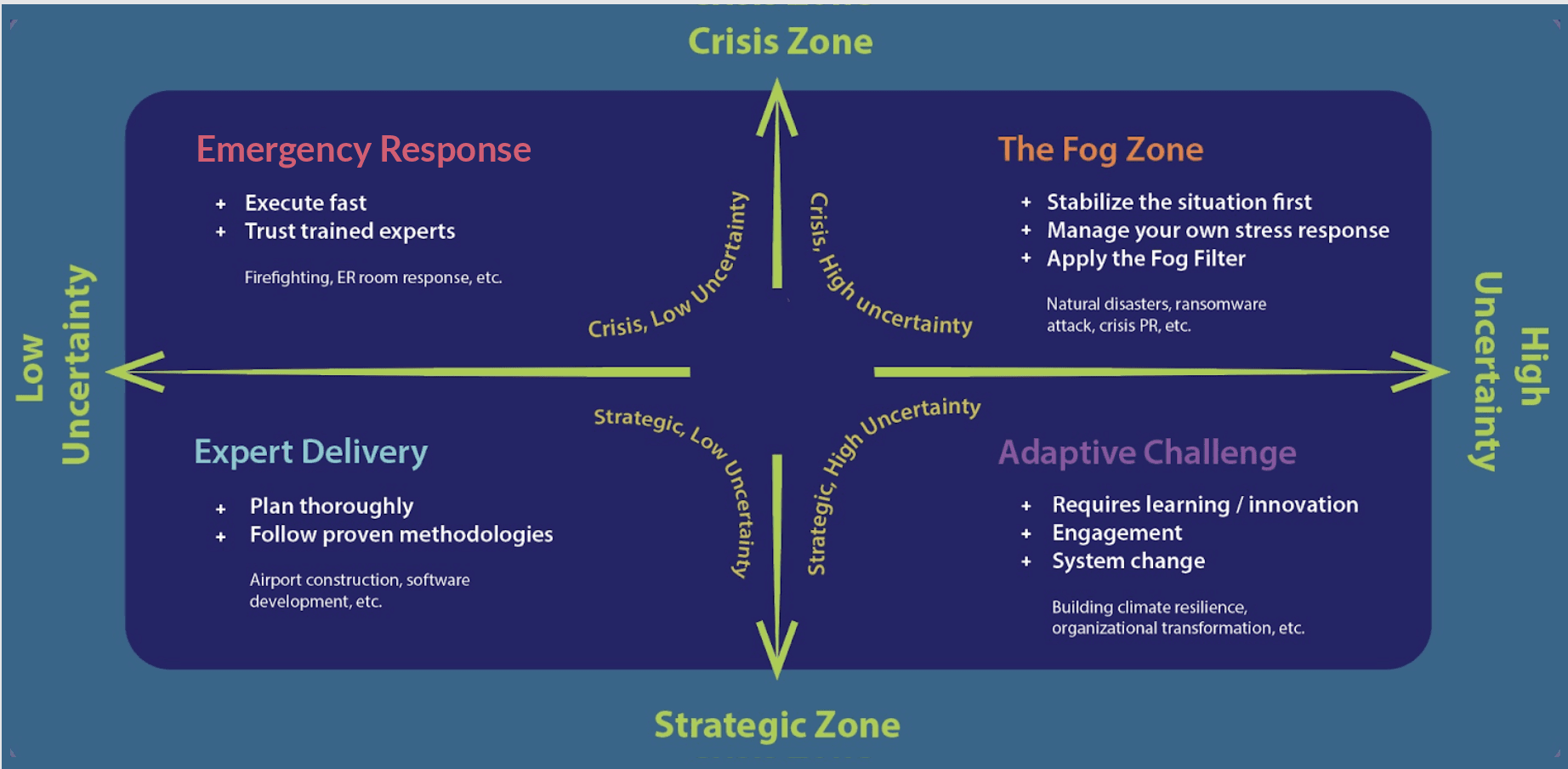
The Two Axes: Uncertainty and Urgency
Uncertainty
Uncertainty has two components:
- Uncertainty about the problem - what is actually happening, what is driving it, and what kind of challenge sits beneath the visible symptoms.
- Uncertainty about the solution - whether there are known, tested approaches that are likely to work, or whether the system must learn its way forward.
Together, these components determine how much the work depends on expertise versus learning. When both the problem and solution are clear, the work sits in the expert zones. When either is unclear, the work begins to move into adaptive territory. When both are unclear, especially under time pressure, the work enters the Fog Zone.
Urgency
Urgency captures how quickly consequences unfold if no action is taken. It affects what the system can absorb, how much time is available for learning, and how reversible early moves need to be.
When urgency is low, there is more space to experiment, adjust, and bring people along. When urgency is high, action cannot wait for full clarity; leaders must stabilize, prioritize, and move carefully enough to avoid making the situation worse while still affecting outcomes.
When uncertainty and urgency are combined, four distinct environments of leadership work emerge.
The Four Zones of Leadership Work
1. Expert DeliveryLow uncertainty · Low urgency
Expert Delivery describes coordinated, planned work in relatively stable conditions. The problem and the solution are understood. The primary task is to implement effectively.
Leaders in this zone focus on:
- clarifying roles and expectations
- sequencing steps
- managing interdependencies
- monitoring progress and quality
The risks are drift, complacency, or hidden complexity that has not been acknowledged.
2. Emergency ResponseLow uncertainty · High urgency
Emergency Response covers situations where the nature of the problem and the required solution are clear, but time is short and consequences are immediate. The work resembles Expert Delivery in content, but the tempo and stakes are different.
Leaders in this zone focus on:
- enabling trained experts to act quickly
- removing obstacles and delays
- making rapid, clear decisions
- keeping communication tight and functional
Hesitation, confusion about decision rights, or unnecessary layers of consultation can cause real harm when time pressure is acute.
3. Adaptive ChallengeHigh uncertainty · Low urgency
Adaptive Challenge refers to work where either the problem, the solution, or both are not yet clear, but the situation allows enough time for learning, experimentation, and adjustment. These challenges require shifts in values, behavior, or roles rather than simple technical fixes.
Examples include culture change, strategy redesign, long-term innovation, or redesigning service models.
Leaders in this zone focus on:
- framing the work clearly, including what is at stake
- bringing in perspectives from different parts of the system
- pacing heat so that people stay engaged without becoming overwhelmed
- surfacing competing interpretations of the problem
- running small, contained experiments to see what works
Treating adaptive work as if it were a technical rollout tends to produce resistance, fatigue, and superficial compliance.
4. Fog ZoneHigh uncertainty · High urgency
The Fog Zone describes situations where both the problem and the solution are unclear and consequences are unfolding quickly. This is a distinct leadership environment. It combines the need for learning with the pressure to act.
Leaders in the Fog Zone are tasked with:
- stabilizing the system enough that people can think and act
- communicating what is known and what is still uncertain
- preventing fragmentation and loss of coordination
- triaging what is deteriorating fastest
- choosing actions that are as reversible as possible while still affecting outcomes
- using those actions to generate better information
This is not a familiar emergency with a known playbook. It is also not slow adaptive work. It requires provisional moves, disciplined communication, and a constant balance between motion and caution.
Why Adding the Urgency Dimension Matters
The original technical-adaptive distinction highlights whether a challenge can be addressed through existing expertise or requires learning and adaptation. Adding urgency to the picture clarifies how time pressure changes what is possible and what is wise.
When uncertainty is high and urgency is low, leaders can create conditions for deeper adaptive work: broad engagement, experimentation, and extended reflection. When uncertainty and urgency are both high, the same intent to engage and experiment must be tempered by stabilization, triage, and a focus on reversible moves.
Likewise, when uncertainty is low and urgency rises, technical work shifts from planned delivery to rapid emergency response. When uncertainty and urgency are both low, slower, more deliberate planning and execution are possible.
Recognizing these differences helps leaders avoid treating all high-stakes situations the same way. Urgency determines how much time is available for learning and how carefully early moves must be chosen.
Using the Framework for More Effective Leadership
The Leadership Challenge Framework is designed to support more effective leadership by improving diagnosis before action. It is a decision aid for real work.
In practice, leaders and teams can use it to:
- classify the type of work they are facing by discussing what is known and how quickly consequences unfold
- align on whether the situation calls for expertise, learning, stabilization, or a combination
- match pace, posture, and communication to the quadrant they are in
- sequence decisions - deciding what must be done now, what can wait, and what must be explored
- reduce conflict that stems from implicit disagreement about the nature of the challenge
Organizations often operate in more than one zone at once. One area may require Expert Delivery, another may be in Adaptive Challenge, and a third may be experiencing Fog Zone conditions. The framework helps leaders hold that complexity.
A Shared Model for Real-World Leadership
The Leadership Challenge Framework provides a shared language for the different types of work leaders encounter. By mapping uncertainty and urgency, it offers a way to see what kind of leadership a given moment requires.
With a clearer diagnosis of the challenge, responses can be better matched to the situation. Leaders can focus on the right work: coordinating expertise, enabling rapid response, creating conditions for adaptive learning, or stabilizing in the Fog Zone while insight develops.
Frequently Asked Questions
What is the Leadership Challenge Framework?
The Leadership Challenge Framework distinguishes four types of leadership challenges by mapping situations along two axes, uncertainty and urgency, so leaders can diagnose what kind of work they are in before deciding how to lead. The four zones are Expert Delivery, Emergency Response, Adaptive Challenge, and Fog Zone. It builds on the technical-adaptive distinction introduced by Ron Heifetz by adding an explicit urgency dimension.
What are the four zones of leadership work?
Expert Delivery is low uncertainty and low urgency, where the problem and solution are known and the task is to implement well. Emergency Response is low uncertainty and high urgency, where the answer is clear but time is short. Adaptive Challenge is high uncertainty and low urgency, where the work requires learning and shifts in values or behavior. Fog Zone is high uncertainty and high urgency, where the problem and solution are both unclear while consequences unfold quickly.
How is the Adaptive Challenge zone different from the Fog Zone?
Both involve high uncertainty, but they differ on urgency. Adaptive Challenge allows enough time for learning, experimentation, and adjustment, so leaders can engage broadly and run contained experiments. The Fog Zone combines that same uncertainty with the pressure to act now, so leaders must stabilize the system, triage what is deteriorating fastest, and choose reversible moves while insight develops.
Why add an urgency dimension to the model?
The original technical-adaptive distinction captures how much is known about the work, but it does not capture how quickly consequences unfold. Adding urgency clarifies how time pressure changes what is possible and what is wise. The same intent to engage and experiment that suits low-urgency adaptive work must be tempered by stabilization, triage, and a focus on reversible moves when urgency is also high.
How do leaders use the framework in practice?
It is a decision aid for diagnosis before action. Leaders and teams use it to classify the type of work they face, align on whether the situation calls for expertise, learning, or stabilization, match pace and communication to the quadrant, sequence what must be done now versus later, and reduce conflict that stems from implicit disagreement about the nature of the challenge. Organizations often operate in more than one zone at once, and the framework helps leaders hold that complexity.